
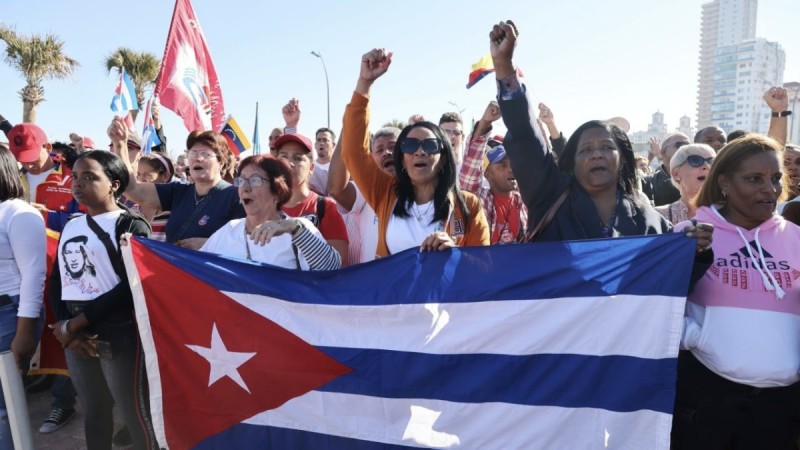
Trump pushes Cuba toward catastrophe

Cubans rally in Havana to stand in solidarity with Venezuela, January 3, 2026. Photo courtesy Presidencia Cuba/X.
In late January, the Trump administration dramatically escalated its long-running economic war on Cuba, signing an executive order that threatens punitive tariffs against any country that supplies the island with oil. Framed by the White House as a national security measure, the order declares a state of emergency and accuses Cuba of ties to hostile foreign powers. In practice, the policy aims to choke off Cuba’s access to fuel, a lifeline for electricity generation, hospitals, food distribution, and water sanitation, in an already fragile economy strained by decades of brutal US sanctions.
The impact was immediate. Mexico’s state oil company suspended shipments, and other suppliers appeared to hesitate under threat of US retaliation. With Cuba able to meet only a fraction of its domestic energy needs, the prospect of a full-scale fuel cut-off has raised alarms about prolonged blackouts, humanitarian collapse, and the risk of military escalation in the Caribbean. As Washington openly speaks of regime change, the order amounts to collective punishment that could reshape not only Cuba’s future, but power dynamics across Latin America and the Global South.
What follows is a conversation between Cam Scott, Samantha Hislop, and Rob Crooks, members of the Canadian Network on Cuba, on what the new sanctions mean, why Cuba remains a target, and what international solidarity looks like when the margins for survival grow dangerously thin.
Cam Scott (CS): This is possibly the most dangerous week in Cuba for many decades, perhaps since the Special Period in the 1990s. The risk of US invasion, of US encirclement and naval blockade, and the threat of US interference against trade partners, is stated and severe. So there’s an awful lot to say, and it’s important to come together and start to think about how we are going to move in solidarity with the Cuban people this week. How is it looking to everyone here at the moment?
Samantha Hislop (SH): As of Thursday, January 29, Donald Trump has signed an executive order which threatens tariffs on any country that provides oil, or fuel more broadly, to Cuba. So that’s a huge escalation in the sanctions and economic asphyxiation regime that the US has been imposing on Cuba for over six decades. It’s probably the most serious measure ever taken against Cuba.
As of right now, to our knowledge, there are no oil shipments on the way to Cuba, and none are expected. Pemex, which is Mexico’s state oil company, has halted deliveries following intense pressure from the United States. While a tanker carrying roughly 85,000 to 90,000 barrels of oil arrived in Havana on January 9, planned subsequent shipments were cancelled later in the month. Bloomberg reported on January 26 that a tanker that had been slated to sail to Cuba had instead turned back, and no further oil has reached the island since the end of January (although the Mexican government has said it intends to uphold its oil supply contract despite US pressure).
We know that Cuba can only supply about 40 percent of its domestic energy needs. That’s how much it produces internally. I know they have been trying to increase their internal production recently, but we know that until now the other 60 percent has to be imported from other countries. So this is a barbaric measure, first of all—I have to say that. This could have severe consequences, because every country needs oil. It’s needed for the most basic of services: for hospitals, surgeries, incubators, dialysis machines, refrigeration, electricity, water sanitation, literally everything. I don’t have to explain that, but Cuba needs oil, and they need to be able to import oil, and the United States has signed this executive order. So that’s where we are right now.
Rob Crooks (RC): I think it’s good that you explained the implications, because a lot of people might think, “Oh, there’s no oil so they can’t run automobiles,” which would be bad enough. You can’t deliver food, you can’t run ambulances and things of that nature. But they need oil to power their electrical grid. No electricity means spoiled food, it means no energy for hospitals. And Cuba has been suffering under this blockade for more than half a century. February 3 is the 64th anniversary of Kennedy signing the blockade against Cuba. And just by chance, it seems to be one of the coldest weeks in Cuba ever. I saw that in some places it’s getting down to zero degrees Celsius, and the country is already having daily blackouts because of the blockade, and because they can’t get the parts they need to update their electrical grid.
So I don’t really know how people are staying warm. And then there are all these other needs that still have to be met. I read an article today saying that the Cuban government has been installing portable charging stations, each paired with a solar panel, in the homes of people who need a continuous supply of electricity because of health conditions like cerebral palsy or muscular dystrophy—people who rely on machines to stay alive. This is a barbaric, genocidal act by the Trump administration, but the Cuban government is doing everything it can to ensure that the impact on the most vulnerable people is as limited as possible.
CS: It’s profound. Those home solar solutions will be a matter of life and death for so many people. And it opens onto the broader question of solar in general, and what assistance is actually en route. When we talk about how crucial oil is to the everyday operation of the Cuban economy, it’s worth noting that Cuba’s energy sector is uniquely vulnerable because it has been inadequately resourced and diversified as a direct outcome of the blockade.
Cuba still relies on a 1970s, Soviet-era power grid that runs on oil. It never made the kind of transition we’ve seen elsewhere, for example to natural gas in the United States. By 21st century standards, this is outmoded infrastructure, and it requires a constant supply of oil to keep running. Last year there was some genuinely encouraging news about Chinese assistance in the form of solar panels, coming amid rolling blackouts caused by much less acute shortages and the cascading impacts of Hurricane Melissa. Cubans were talking about building roughly 90 solar parks by 2027. That would be a huge advantage and fits their long-term environmental planning—but it’s not the kind of retrofit you can carry out with three weeks of oil left.
Cuba’s Díaz-Canel: “The naval blockade against Venezuela began in December. Since that date, no fuel has entered this country.”
Council of Ministers has prepared an updated decree based on the 1990s Special Period framework, the emergency measures enacted after USSR collapse pic.twitter.com/vYQ9CrnEiZ
— COMBATE |?? (@upholdreality) February 5, 2026
RC: And this order from Trump, where he calls Cuba a threat to national security—nobody believes that. First it was claims that China has spy bases in Cuba, now it’s that Russia has spy bases. We even saw the Havana syndrome narrative being dragged back out in some reports. It’s ridiculous. Now Trump is saying that Cuba isn’t going to last long. Rubio is openly saying, “we want to see regime change in Cuba,” even after the Senate formally condemned regime change. And Maria Elvira Salazar is talking about how she doesn’t care if children and mothers die, because that suffering will supposedly serve a greater good. They know how lethal this measure will be. They’re just ghouls.
And of course this comes in the wake of the kidnapping of Nicolás Maduro. The United States has a very poor record when it comes to attempting to invade Cuba—they’ve failed every single time—but Cuba isn’t ruling anything out. I read an article from the Associated Press saying that this is already affecting the US relationship with Vietnam, where internal documents describe the United States as an existential threat because of what happened in Venezuela and what’s happening with Cuba right now. Even though the two countries have trade deals and are, in some ways, allies, the Vietnamese government isn’t falling for it. They’re being very cautious because of what they see unfolding in the Caribbean and Latin America.
SH: The US is emboldened with every step it takes without pushback. That’s one reason Cuba is so important: if something happens to Cuba, the whole world—not just the region, and especially the Global South—will see it. It would change everything internationally. Sovereignty would lose its meaning, because Cuba is the epitome of independence.
CS: And this is why the executive order has to exaggerate the threat Cuba poses. On one hand, we should absolutely condemn this fabricated account of threat. Miguel Diaz-Canel and many others have said very plainly that Cuba poses no threat to the United States in any of the ways this executive order claims—but let’s also be real among ourselves.
Cuba poses a serious obstacle to US global ambition despite its small size, because it is a central node in a network of counter-hegemonic and anti-systemic projects that the United States has sought to dismantle since the counterrevolution in the USSR and the attempted re-colonization, or neo-colonization, of many Non-Aligned Movement countries. It has not only implemented these projects on its own territory but also projects a vision of a democratic, equitable, humane, planned economy. In that sense, it is an ideological threat, at least to the United States.
The specific accusations that led the US to place Cuba on the State Sponsors of Terrorism list—relating to its ties with Colombia, Palestine, and other countries—are basically a fraudulent recasting of its international relationships. The simplest explanation is that the United States is trying to complete its capture of the region, and Cuba is probably the major bulwark against that vision.
We have to imagine the effects this total blockade will have—this comes on the heels of the movement for a free Palestine, with the world watching Gaza in riveted horror as starvation is used as a weapon. And yet, when even right-wing Cuban outlets call this collective punishment, when they say it will crush the entirety of the Cuban people, how long will it take for that reality to break through?
Someone like Carlos Giménez is an absolute traitor. His family were wealthy landowners under Batista, and he’s one of those Florida representatives promising to asphyxiate his own people. We can immediately see how any sense of “people” is cleaved by class, with someone like him openly saying there will be no oxygen for Cuba. This is as despicable as it gets. And yet he goes further, telling everyone in Cuba—get on a plane, come home. All tourists should leave, because it’s about to get very bad.
Demonstration outside the US Embassy in Havana, demanding an end to Washington’s decades-long blockade of Cuba, December 2024. Photo by Ricardo López Hevia.
RC: The embassies too—telling people in European missions that they’d better get out now while they still can. When you say that, it means you know exactly what you’re doing, exactly what you’re trying to achieve.
CS: What concerns me are these characters. I know we’ve been trying to keep a roster of the right-wing legislators who are part of the anti-Cuba lobby. They, I believe, are the underrated factor in this sequence, because Trump is a vaporous, mercenary personality—but he’s being operated by these hardcore, sadistic people whose entire political vocation is to crush Cuba, and they’ve been designing this program for decades. I’ve seen some people whose optimism isn’t connected to the solidarity movements or to the incredible resiliency of the Cuban people. They expect Trump to change his mind; he vacillates by the day. It’s this very passive thing. He’s desensitized all of us, I believe, by behaving so erratically. But I really think this might be different, because Trump is not the operator of this sequence. People should be looking at Rubio and the hardcore anti-Cuba ideologues who are using Trump.
SH: You could see it in the press conference where they announced the executive order: all three of them were there—Carlos Giménez, Maria Elvira Salazar, and Mario Díaz-Balart. They were giddy, gleeful, standing right beside him. And that other lobbyist—the one who came to Canada and did that tour to discourage Canadians from going to Cuba? Orlando Gutiérrez-Boronat, from the Assembly of Cuban Resistance Lobby Group—he was there too, and he was happy. They’ve been working toward this for a long time. This is the highlight of their careers and their lives. Nobody should expect Trump to change his mind on this.
RC: One of the funny things, too, is that Trump has said he wants to “make a deal” with Cuba. But the Cuban government says that while they’ve been in contact, they’re not discussing any deal. I believe their last communication was through Mike Hammer, the chargé d’affaires to Cuba, who did a couple of public events at churches in Cuba—where the US thought they might have a better chance of reaching people. But he was yelled at—they were calling him a murderer, calling him an imperialist. And the US spun this as “the Cuban government attacking Mike Hammer.” The most recent update I saw was the Cuban government assuring the US that Mike Hammer will be safe, and that they won’t let anything happen to him.
CS: As for the manipulation of churches as a reserve of counter‑revolutionary sentiment: this is somewhat true. Some of Cuba’s bishops are calling for reforms, despite the robust religious freedoms that already exist in Cuba. But the churches—and the Pope in particular—have come out strongly against the US escalations and this total blockade. Because it won’t discriminate; it’s going to reach every single person in Cuba.
The situation right now feels extremely dire. Claudia Sheinbaum in Mexico has claimed that the decision to stop oil shipments was a sovereign one. Clearly, though, this took place under duress and under direct threat from the United States. Mexico has since pledged humanitarian aid and, as of a day or so ago, potentially shipments of humanitarian oil. So what happens now? What needs to happen to break—or at least circumvent—this blockade?
RC: I think there’s a lot going on behind the scenes that we don’t see. In general, the international community is appalled by this. At the UN, they’ve stood against the blockade every year since 1992. At this point, we need more than words. It might seem easy to criticize someone like Sheinbaum in Mexico, but I think they’re trying to negotiate with the US to see what they can do—how they can send oil without triggering tariffs. This may seem like capitulation. And if you don’t stand up to Trump now, what’s going to happen? At the same time, Mexico cannot afford the tariffs Trump is threatening, given how much they export to the US market. They’re in a very vulnerable position.
SH: But there are other countries—supposed allies of Cuba, BRICS members—that should have more resilience against US economic threats. They need to stand up. There needs to be a united response. Any single country alone is too vulnerable, but together, they can do something. If countries, especially the largest economies in this hemisphere, coordinated and studied their vulnerabilities versus those of the US economy in terms of trade, they might find leverage. I’m not an expert in trade, and of course this would affect jobs—but much of what Mexico exports to the US, for example in the auto sector, goes to American corporations. So it’s not just Mexican companies that would lose out; US corporations themselves would be impacted by tariffs.
Imperialism thrives on fragmentation, and right now everyone is looking out for themselves, trying to delay the inevitable. But you’re next on the menu. If the US can do this to Cuba—the most resilient, independent country, the one that has shown the greatest solidarity and internationalism since the revolution—then after Cuba, you’re next.
RC: This is poignant, because this episode didn’t start with Cuba. We have to remember that it started with Venezuela and then moved to tighten the screws further with tariffs on any country that supplies fuel to Havana.
SH: They were blowing up boats in the Caribbean, killing fishermen, with no consequences at all. And that’s why they decided, okay, we can do this in Venezuela. It’s outrageous.
CS: The attacks on Venezuela choked off Cuba’s major oil supplier, paving the way for the present tariff regime. It’s like dominoes. And without getting into wild speculation about the ways that the United States and Israel might seek to manipulate uprisings originating from the bazaar in Iran, it’s not a coincidence that Iran, which could be a potential ally in this situation, is quite out of commission.
Now Iran was never a major vendor, I want to be clear, because I think we should resist this tendency to produce a kind of ‘fantasy baseball draft’ within the BRICS and ask, “Where are all these other countries? Why aren’t they sending oil?” I’ve been doing that too. I’m thinking, well, China has oil fields and refineries, but it’s not a major oil‑exporting country; they’ve sent rice and other material aid. Brazil is an oil‑exporting country and nominally allied to Cuba, and is one of its major trade partners where food supplies are concerned. One can get ahead of oneself thinking about this, but the logistical regimes even before any punitive tariff system are very complex. It’s really hard to make this up overnight. Even so, when we look at the tanker with Venezuelan oil that was apprehended in advance of the January 3 attacks, I believe that that was an Iranian ship. So you can see how all of these sequences are wrapped up in one another. But the pretense is so inconsistent.
RC: We also know that there are US and Canadian ships in the Caribbean Sea right now, and I don’t really know what they’re doing. According to the Government of Canada website, the HCMS Yellowknife is there to fight drug trafficking. But is that what it’s really doing? Could they be acting as a physical blockade against anything going to Cuba? This is speculative, but if that were the case, would the same rules apply to a Russian tanker? You talk about how the US is engaged in Iran right now; they’re threatening Greenland. Is the US positioning itself for a much wider war? And are other countries seeing that and deciding they don’t want to be the spark that sets it off?
This discussion originally took place on a February 4 episode of the podcast In Defence of the Revolution. It has been edited for clarity and length. Sign the petition to the government of Canada: Let Cuba Live!