
Conflict gold and ‘chequebook diplomacy’

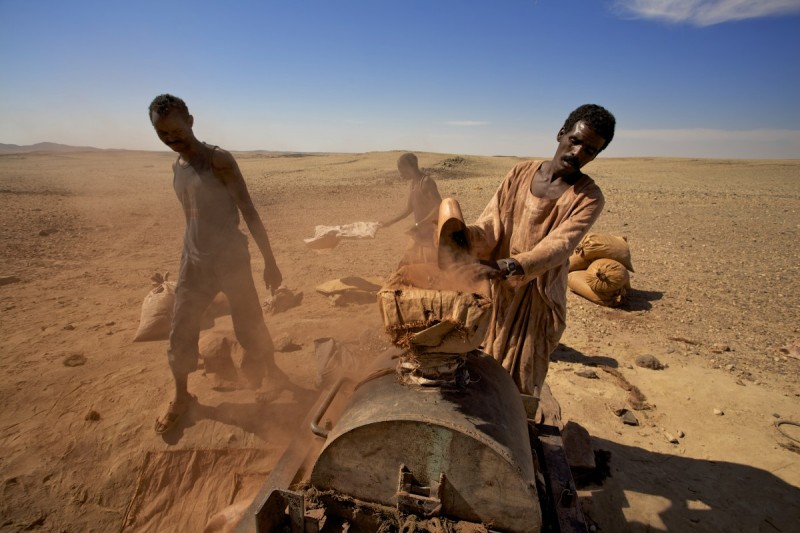
Gold prospectors grind up rock debris before washing it to extract the gold it contains, North Sudan, Fourth Cataract Nile Region. Photo by Maciek67/iStock.
Over a decade ago, Sudan was split along the arteries of oil. Today, the lines of division and blood money flow along gold veins—and the yet-untapped riches beneath its soils.
Characterized sometimes as a civil war, and other times as a proxy or even regional war, the current conflict in Sudan has elements of each without fully fitting into any single category. It is as much a product of Sudan’s failure to root out deeply entrenched corruption, tribal feuds, and religious fundamentalism as it is of broken promises of peace and civilian government transition—and of meddling by foreign actors.
With war continuing toward its third year, Sudanese families remain divided, Sudanese nationals have been banned from entering the United States by the Trump administration, and refugees have been deported from neighbouring countries. Sudan now stands at a vital crossroads. Pushed out of the east-central region of Ghezirah over the past year, the paramilitary Rapid Support Forces (RSF) seized North Darfur’s capital of El Fasher in October, and has since pushed deeper into the Kordofan region. The RSF’s control now decisively spans Sudan’s western peripheries near Libya, Chad, and South Sudan.
The paramilitary’s bloody campaign has slaughtered civilians, terrorized women and children with mass rape, and routinely restricted humanitarian aid deliveries. Children have been exposed to brutal violence and even recruited into the rank-and-file of genocide that has targeted Fur, Masalit, and Zaghawa peoples. Mass displacement has opened space for the RSF to control Sudan’s vast western states, using intimidation and extortion to retain a grip over mining communities. And as the years pass and the war drum beats on, Sudan’s minerals lie in the foreground of the country’s troubled past and future.
Hands wide open
“You cannot negotiate with someone who is actually the aggressor himself,” Mohamed Bashir Abunommo, Sudan’s former minister of minerals, said at a trade show in Toronto last March, where the government of Abdel Fattah al-Burhan—general of the Sudanese Armed Forces (SAF) and head of the Transitional Military Council junta that seized power after the Sudanese Revolution—was soliciting investment.
Soldiers, weapons, vehicles, and ammunition are costly, and since the 2019 ouster of Omar al-Bashir, Sudan has continued courting foreign investment in its natural resources sector. An updated Investment Act was passed just months before the 2021 military coup led by al-Burhan, in time for mining deals with companies from Iraq, China, and South Africa. Military officials remained in power, and when war erupted in 2023, business did not slow—it accelerated. Within a year, Sudan was signing agreements with companies from China, Qatar, and Russia. “Sudan’s gold industry rebounded,” Bloomberg reported. Through 2025, fresh deals—including plans for a Qatari gold refinery—continued to be inked.
Is war a good time for mining deals? Abunommo declined to comment on the agreements and would not confirm whether Canadian investors had expressed interest. Saying he did not want Sudan to fall prey to the “resource curse,” he envisioned mineral revenues financing agricultural development and the Port of Sudan on the Red Sea. The decades-long oil boom, he argued, had left Sudan’s other mineral sectors underdeveloped. Gezira state, the country’s breadbasket, lay newly ravaged by massacres and on the brink of famine as years of bitter fighting between the army and the Rapid Support Forces pushed the tides of conflict back and forth across the country.
“These people have been defeated internally—militarily defeated,” Abunommo said, referring to the RSF. “They are now seeking to have some kind of lie, some kind of media propaganda outside the country to establish the so-called parallel government. No country is going to agree with them. For us, it is nonsense.”
Nonsense it may have been for the junta, but the RSF announced a parallel government this past August, with RSF military head Muhammad Hamdan Dagalo Musa, known as Hemedti, committing to Sudan’s “sovereignty” and “a secular, diverse, and democratic rule.” Neither the African Union nor any international government recognizes the paramilitary as a legitimate authority.
Abunommo was adamant about the RSF’s failure to uphold the Jeddah Agreement, a short-term ceasefire agreement signed on May 21, 2023, which was supposed to enable humanitarian aid delivery, the restoration of essential services like medical care, and end the military use of civilian infrastructure like hospitals. It was routinely violated. The RSF has since ruptured an 18-month siege on North Darfur’s capital of El Fasher—home to many refugees from the Darfur genocide—and launched offensives east into North and South Kordofan.
Abunommo himself is a lead negotiator for the Sudan Liberation Army’s Minnawi faction (so named for its leader Minni Arcua Minawi), a largely Zaghawa (a transnational semi-nomadic ethnic group in western Sudan Chad and Sudan) rebel movement that has allied with the army in Darfur. He reflected a hardline stance that has been repeated through the war by junta officials rejecting the paramilitary’s legitimacy, with Malik Agar Ayyir, deputy chairman of the Transitional Sovereignty Council (TSC)—and former Blue Nile governor and insurgent leader—rejecting Hemedti’s claims of “democracy” in December and calling the war a “conflict over resources and a desire to change Sudan’s demographics.”
The past year saw the warring junta and paramilitary forces grappling over political legitimacy. Former UN official Kamil Idriss was appointed prime minister by the TSC in May. Shortly after taking power, he dissolved cabinet. Abunommo was among the ministers dismissed. And while Idriss presented the UN Security Council with a peace plan on December 22, demanding the RSF give up territory, warring parties have yet to accept any agreements, including joint efforts by the US, the United Arab Emirates, Saudi Arabia, and Egypt.
“We never accept the mediation from the UAE, because the main aggressor in our war is backed by the United Arab Emirates,” Abunommo added. There was mounting criticism of the UAE at the time for financing the RSF, facilitating gold smuggling, and supplying mercenaries. “All the facilities, the military equipment, all the logistics, and all the weapons that come through Chad, were financed, logistically managed by the United Arab Emirates,” he said. The UAE have consistently denied accusations of covertly supplying weapons to and financing the RSF.
With the front lines shifting into North and South Kordofan, the RSF has tightened territorial control and dominance over resources in Sudan’s west. And with mounting allegations and evidence over private sector links to Emirati actors, the paramilitary’s role as a UAE proxy in the Greater Horn of Africa is coming into focus.
Mohamed Bashir Abunommo, Sudan’s former minister of minerals. Photo by Lital Khaikin.
Blood gold
Gold and oil, long at the heart of Sudan’s ancient Nubian trade, remain central to its economy—but today they drive conflict as much as they generate wealth.
“Gold has been the paramount resource used by both warring parties to fuel and sustain this conflict,” said Ahmed Soliman, Horn of Africa expert at Chatham House, in a video interview with Canadian Dimension. With good reason: Sudan is Africa’s third-largest gold producer, after South Africa and Ghana, and prices have reached historic highs not seen since 1979. Most of the country’s gold comes from the northeast—around the Red Sea, the Nile River, and Northern State—territories controlled by the SAF that have long attracted foreign investment and commercial mining interests.
Mining has been a major revenue source for the RSF in Darfur. In the years before the 2021 military coup, the Jebel Amer gold mine in North Darfur became a flashpoint for conflict as artisanal miners arrived from abroad seeking fortune. Tensions escalated, and accusations resurfaced that the Bashir regime was manipulating rivalries. Sudanese scholar and Rift Valley Institute fellow Magdi El Gizouli stated in 2018 that the government was deliberately stoking conflict “to get artisanal mines under its control.” Within two years, the RSF took control of Jebel Amer and eventually expanded toward the Sungu mines in South Darfur’s al-Radom region.
If Sudanese officials like TSC chairman Agar view the war as a resource-driven conflict, it’s not just about gold. The Ministry of Minerals also reports “huge deposits of marble” in Darfur. Less glamorous but economically important, North Darfur contains potassium nitrate (used in fertilizers and other domestic products), while lead and graphite were identified in the region decades ago but remain undeveloped.
According to 2023 state data, most mining concessions in Darfur are concentrated in South Darfur. The Special Administrative Area of Abyei, long known for its oil fields, has had a disputed status since South Sudan’s partition and continues to face a long-neglected humanitarian crisis despite a UN peacekeeping presence. As the RSF consolidates control over Sudan’s western states, Abyei’s situation has recently risen to the forefront of the Security Council’s concerns.
Darfur’s copper potential has long simmered. In October 2017, the US lifted sweeping economic sanctions on Sudan, and a month later the state-owned Ariab Mining Company claimed that the al-Qutb site holds the world’s largest copper reserve. South Darfur has been slow to develop this critical mineral, with mines in the al-Radom region long abandoned. Still, its strategic importance is clear: as insurgencies raged through 2010, South Darfur’s governor declared that the copper discoveries belonged to the state and would not become another Abyei.
A landlocked region with vast, remote areas, Darfur has remained largely underdeveloped and cut off from global trade corridors. Systemic neglect by the central government has long masked the region’s complex undercurrents of rebellion and disputes over power-sharing with Khartoum. “There is nothing significant to lose from those areas,” Abunommo said, adding that in “the worst scenario” of losing territorial control “there will be no effect from it.”
On December 8, the RSF seized the Heglig oil field in South Kordofan, where a pipeline runs from South Sudan to the Khartoum refinery. With most government revenue for both Sudan and South Sudan coming from oil exports, both countries are effectively at the mercy of the paramilitary. By November, Sudan’s economy had already contracted by nearly a quarter. The RSF described the takeover as “a pivotal point in the liberation of the entire homeland, given the region’s economic importance.”
It’s unclear how much of Sudan’s wealth has ever truly belonged to its people. By 2020, the country hosted at least 144 franchised companies in the mining sector, fewer than half of them Sudanese-owned, with only nine actively in production. Most commercial activity focuses on processing tailings, while the majority of extraction is artisanal and informal, relying on crude methods using mercury and cyanide—leaving both workers and communities in a state of precarity.
Gold amounted to 48 percent of all Sudan’s exports in 2024, with 97 percent exported to the UAE. The UAE also claims the majority of gold exported from SAF-controlled territories, earning the junta over $1.5 billion in 2024 alone, according to the Central Bank of Sudan (Sudan has since sought alternatives in exporting gold to Oman and Qatar).
Despite its significant mineral and oil wealth, Sudan has for years lost billions in revenue from key economic sectors, with the former president embezzling billions or using funds to finance counterinsurgency as the country plunged deeper into debt. This opacity continues amid the ongoing turmoil of war.
‘Chequebook diplomacy’
Political alliances have dug trenches across Sudan. “Whereas Egypt and the United Arab Emirates may be benefiting short-term from this gold, their pursuit of opposite interests risks fragmentation of the country and further destabilization,” Soliman said. “Very early on in the war, the UAE used chequebook diplomacy to buy off the Chadian President and the Chadian government.”
In 2023, Chad’s President Mahamat Déby signed a military cooperation agreement, exchanging training and equipment to combat Boko Haram and the Islamic State in West Africa Province. The alliance has been controversial, not only because foreign fighters from Chad joined the RSF, but also due to historic tensions between Sudan and Chad. Former President Idriss Déby’s familial Zaghawa lineage and past alliance with the SLA’s Minnawi faction add further volatility to militia loyalties on both sides in a region long scarred by state and non-state violence.
Gold hubs and transit routes have further anchored the UAE’s interests. The Sentry, a non-profit investigative and policy organization, has been tracking the paramilitary’s illicit financial flows and finds that the RSF’s financing model has become heavily dependent on the gold sector since the war began.
It’s a tangled web. Over a dozen companies have been linked to RSF leader Hemedti, either through family-owned businesses like Al Junaid or by proxy. Across Sudan, Rwanda, and Mali, numerous firms are suspected of serving as RSF fronts or of being connected to Emirati actors. They range from jewelry traders and furniture stores to management consultancies, a car company converting tactical trucks, logistics firms, and a private security company. Some have changed leadership or dissolved, while others appear to be part of a network supporting the RSF from Dubai since 2019.
Several companies and leaders have already been sanctioned. But others, like Aoun Commercial Brokers, remain untouched despite what Sentry investigator Nick Donovan described in an email as “several red flags suggesting likely links to the RSF.” RSF front companies may trade with one another and share directors, Donovan added, including those already sanctioned. Digital red flags include “shared addresses and emails, and infrastructure such as co-hosting websites on servers used by small numbers of companies.”
The UAE may have recently expressed regret over not sanctioning Sudanese officials, but its denial of support for the paramilitary has fueled calls to sanction blood-gold supply chains and RSF financing. By identifying Mazin Gamareldin Mohamed Fadlalla as a leader of numerous front companies, The Sentry is calling for closer scrutiny of company shareholders and greater due diligence from banks and businesses in the gold sector.
Gold has become both a lifeline for local communities and a driver of Sudan’s ongoing conflict. An estimated 75 percent of the country’s gold is smuggled, with tens of kilograms leaving each week for black market sale, enriching militias and foreign buyers while deepening corruption and instability. Photo courtesy Sudan Democracy First Group.
Deadly deals
The extractive sector has long underpinned the unrelenting storms of political violence under Omar al-Bashir and in the years following the Darfur genocide, when foreign governments propped up his regime and downplayed the humanitarian toll of protracted conflict.
Canadian mining company Orca Gold has not operated in Sudan since 2022, when it was acquired by Australian partner Perseus Mining. Yet it has faced renewed criticism from Sudanese activists for its dealings with both the junta and Bashir’s regime, and as an example of Khartoum’s central government systematically overriding regional interests—a key flashpoint in decades of conflict.
Making a significant discovery in 2014, Orca had been exploring the Nubian Desert near the Egyptian border, about 700 kilometres north of Khartoum, with plans for open-pit mining. Artisanal and small-scale mines in the area were recognized as “mostly illegal and unlicensed.” With sweeping US economic sanctions on Sudan eventually repealed, Orca’s project received government approval in 2019. Political turmoil following the Sudanese Revolution soon reached a fever pitch, but the company emerged unscathed.
Days before the military coup on October 25, 2021, the Canadian company received final approval from Abunommo. “Contrary to media reports of instability in the Sudanese political environment, we can confirm that it has been business as usual for our operations to date,” Orca CEO Richard Clark said at the time. The day after the coup, Orca said it was not impacted “by the civilian protests or actions of the military.”
The commercial mining project was hailed as a future economic boon as Sudan sank deeper into national debt and key oil revenues were lost following partition. Local protesters saw it differently. After the Perseus takeover, youth activists denounced the lack of consent from Sudan’s Red Sea State despite approval from Khartoum. In the months leading up to the war, protests erupted across the country—spanning South Darfur, West Darfur, Red Sea State, and South Kordofan—over corporate land monopolization and the environmental and health impacts of toxic mining practices.
According to Ahmad Soliman, after foreign companies shut down operations and fuel and chemical shipments declined at the start of the war, there was an urgent push to restart gold production. Authorities reduced taxes on companies and artisanal miners to incentivize direct trade through the government and the Port of Sudan—and to help finance the war. Though communities were “demanding an end to encroachment on what locals see as public property,” Soliman said, the pressure to fund the conflict outweighed their concerns, resulting in an “increasingly violent clampdown by security forces.”
With pressure mounting to end conflict, peace settlements should legitimize the livelihoods of “over a million Sudanese people involved in artisanal mining,” Soliman added, and ensure “their interests aren’t harmed any further.”
Isn’t success built on failure? The 2020 Juba Peace Agreement, signed in South Sudan between the army and rebel groups united under the Sudan Revolutionary Front (including Minnawi’s SLA faction), laid out plans for reconstruction and development across Sudan’s regions. It also promised reconciliation, political representation, and security guarantees for civilians. For Darfur in particular, the deal included annual transfers of $750 million from the Sudanese government to a peace and development support fund for over a decade, plus an additional $100 million within one month of signing. Mineral-producing regions were promised “special rights” over revenues from their resources.
Praised by foreign governments, the Juba agreement was controversial and rejected by some rebel groups who then refused to recognize Hemedti as a TSC authority. Many of the agreement’s promises remain unfulfilled, and not only for Darfur.
Canada has trailed behind the US in sanctioning companies and warlords linked to the RSF. Former resident diplomat Nicholas Coghlan clarified Canada’s continued inaction in a speech at Harvard in December about Canada’s diplomatic interest in Sudan being driven by the presence of Calgary oil company Talisman Energy—accused of fuelling conflict.
Despite public pressure, Canadian Prime Minister Mark Carney has remained silent on Sudan. “There was almost no pushback in Canada,” Coghlan said. Carney instead signed a deal with the UAE in November that will see the Gulf country invest CA$70 billion in Canada, and expand Canadian pension funds into the UAE’s energy, infrastructure, and AI sectors. The national priority of diversifying trade away from the US has only pushed Canada closer to the Gulf. “We will deal with whoever we have to,” the former diplomat said. “It’s lamentable, but that’s the reality.”
Despite the vaunted appointment of Idriss and the renewed promise of civilian government transition, Sudan still hangs in political limbo. Broken promises pave the country’s future. Though a ceasefire was agreed upon by the RSF in November, Nyala was besieged by army airstrikes within a month. The paramilitary group then captured the Babnusa transport junction and army base. The following month, over 100 civilians were massacred in a drone attack in South Kordofan.
“We must not allow Kordofan to become another El Fasher,” UN human rights chief Volker Türk said, even as air strikes continued to batter major cities. The UAE, meanwhile, has entrenched itself as the largest foreign investor in Africa. In war and in peace, Sudan is yoked more tightly to the will of Gulf countries, its peripheries remaining in a chokehold of inequity and impossible choices.
Lital Khaikin is a freelance journalist and author based in Montréal, and regularly contributes features on humanitarian and environmental issues related to underreported regions and conflict zones.