
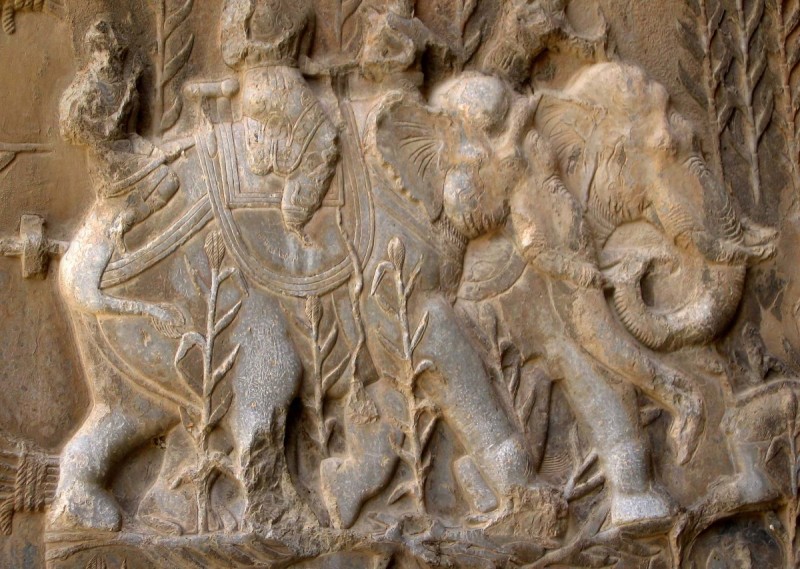
The multiplying Persian elephants

Sasanian relief of boar-hunting on domestic elephants, Taq-e Bostan, Iran. Photo by Alieh Saadatpour/Flickr.
“I found myself wondering why we cannot regard another country, in this case Iran, as just that, as one more country which we regard as neither friend or foe, with whom we are prepared to deal on a day-to-day basis, neither idealizing it nor running it down, keeping to ourselves… our views about its domestic political institutions and practices, which touched our interests—maintaining, in other words, a relationship with it of mutual respect and courtesy, but distant.”
—George F. Kennan, March 8, 1998
History is destiny. Full stop.
If we ignore history, there is little reason why the United States and Iran should not be allies or at least trading partners. Iran has oil and the US has an oil-based economy—what’s not to love? Well, to borrow a line from Joseph Heller, there is only one catch: in the world of geopolitics, history is destiny. Reason, less so, and in most cases, it cannot overcome events and the passions they inspire until they fade from cultural memory. And the Middle East is a region of long memory. Reason is “the slave of the passions,” and as much as anything, malice and error drive the interactions of nations.
In 1953, US and British intelligence helped engineer the overthrow of Mohammad Mosaddegh, the democratically elected prime minister of Iran, in a clandestine operation called Ajax. In the logic of the Cold War and subsequent US foreign policy, support for the coup falls under the burgeoning category of “Seemed like a Good Idea at the Time.” It has been paying dividends of ill will for more than seven decades, most notably when the US embassy was captured by militant students in November 1979. The two nations have been enemies ever since. The larger lesson is that much of the world runs on bad decisions and subsequent grudges, righteous anger, ideology, and other forms of irrationality. These things may even take precedence over the realistic pursuit of national interests as a basis for policy. History is thus destiny driven by bad blood.
But now, after 46 years of repressed neoconservative fantasies—dreams stymied by the strategic conundrum of what to do if Iran were to shut down the Strait of Hormuz following a hypothetical American attack—the US finally has its war with the Shiite state. How did Iran respond to the joint Israeli-American attacks? Well, they shut down the strait through which 20 percent of the world’s oil and one third of its fertilizer passes. Perfect. It was their most obvious strategic card to play, and—like an ace in the hole that everybody knew was there—they played it. And so, in the Great Game of the Middle East, an opponent beat us with a strait. Talk about destiny.
And the result? Never before has an underestimated nation defeated the US so decisively, so quickly, and so predictably. Sure, there were the helicopters hastily departing from the roof of the US embassy in Saigon in the spring of 1975, but that loss came after years of hard fighting. The departure of C-17s from Hamid Karzai International Airport in August 2021 was equally harried, but by that time US ground forces had been in-country for nearly two decades. Questions about how Iran would fare in a toe-to-toe, on-the-ground shootout with US forces now seem pretty much moot. After all, they have won in a strategic sense in the same way that one may win at chess with few actual casualties on the losing side. It’s called being over a barrel—an oil barrel.
This is because the US is not a practical proposition without access to cheap oil, and everybody in the world knows it. Iran believes it can outlast the deeply divided, gas-guzzling Great Satan in a midterm election year, with gas prices likely to remain high. To win the war, all Iran has to do is survive. By contrast, in order for the US to achieve its goals, it would somehow have to install a sympathetic Iranian regime—not bloody likely. Iran’s strategy, therefore, will probably be to stretch things out by flirting with peace proposals and ceasefires while trying not to trigger further US-Israeli bombing and missile attacks. It is in the interest of both nations to lower the intensity of the war, but it is in Iran’s interest to put off a settlement. As John Mearsheimer has suggested, if the war does escalate, the Iranians can always use their Houthi allies in Yemen to attack shipping in the Red Sea—another strait they could play. If only the ghost of Jimmy Carter could have warned the administration about Iranian guile.
And so, after a career characterized by resilience—and with more lives than a herd of cats—the current American president may have sealed the fate of his administration. As with so much of US foreign policy these days, it is easy to be shocked by the war with Iran without being particularly surprised. Still, the decision to attack, although somewhat expected in light of recent events, is perplexing. How could a president who ran on a platform of no more forever wars have gotten the nation into a conflict with no apparent strategy, no apparent way out, and one that played itself with the historical equivalent of Newtonian determinacy? Again, the answer appears to be that history is destiny and that the decision to attack Iran appears to have been shorn of historical understanding. Perhaps, like Venezuela, the president thought that he could affect regime change in Iran without escalation. Who knows?
It is possible that he will see misdirection as a potential way out. He could pull a Grenada—like Reagan after the bombing of the Marine barracks in Beirut in 1983—and change the subject by invading a Caribbean island, this time Cuba. To take Cuba would also make Secretary of State Marco Rubio a patron saint for many Cuban Americans and would position him nicely for a future presidential run, perhaps upstaging Vice President JD Vance, reportedly a skeptic of the present war. But in spite of its manifold problems—and like Iran in 2026 and Cuba in 1961—Cuba today could be a tougher nut to crack than some might believe. In fact, haven’t we seen this film several times before? Someone who has the president’s ear says that the good people of an inconvenient, poorly led nation are ready to cast off their unpopular, strongly ideological leadership, if only given a little push. One result of this kind of “slam dunk” thinking was the Bay of Pigs fiasco. Another may be the current price of gasoline. Of course, the idea of starting another conflict in order to distract from an existing one is a high-risk gamble that does nothing to end the first war.
The other options are: declare victory at the slightest sign of good news via third-party talks and hope that the oil markets rebound; escalate by trying to force the strait open, thus risking another never-ending war, continued escalation, and perhaps World War Three; or let the war fester ambiguously in an increasingly chaotic region in the hope that it will eventually “simmer down.” There are obvious problems with all of these choices, and of course the enemy also gets a vote in how things play out.
Eleven years ago, I wrote an article for the Georgetown Journal of International Affairs titled “The Persian Elephant in the Room.” The “elephant” was the fact that, regardless of treaties, and short of an all-out war that would bankrupt the US and leave the Middle East in ashes, Iran will one day have a nuclear weapon. I stand by this prediction today, and the reason is simple enough: if US wars of choice since 2001 have taught the world anything, it is that nuclear powers get negotiations, while non-nuclear powers that do not go along with the program get attacked, sometimes invaded, sometimes occupied. Nuclear weapons are therefore insurance policies against potential aggressors. The present war underscores the point, and the stated casus belli—Iran’s nuclear program—underscores its own legitimacy from their perspective.
As for claims that Iran wants nuclear weapons in order to destroy Israel, this would seem to be a red herring. Israel is upwind of Iran, and the radioactive fallout from a nuclear attack would literally blow back on the attackers. More significantly, the return address of an Iranian nuclear attack on Israel—a nation assumed to have between 90 and 400 nuclear warheads of its own—would be Iran. The Iranian leadership would therefore have to be either stupid or suicidal to launch a nuclear attack on Israel, and a civilization does not last for 30 centuries in a neighborhood like the Middle East by embracing stupidity.
After all, Iran is Persia—a fact that should be the starting point in guiding all US strategic planning in the region. As a civilization, Persia/Iran has survived Alexander the Great, the Romans, the early Muslim invasions, the Mongols, the Ottomans, the 19th century Great Game between Britain and Russia, and the later Great Game of the Cold War. Just as Iran is not likely to act stupidly or suicidally, neither will it, as an old and proud nation, suffer being bullied. Thus, the desire for nuclear weapons would give it a card to play in warding off attacks by regional rivals and global hegemons alike. For now, Iran may not be able to attack the US directly, but there are other ways it can fight back asymmetrically. Fighting a nation you do not understand and whose history you do not know is like fighting a stranger in a bar: it may not go the way you want it to go, and it may not be over when you want it to be over.
The elephants in the room have multiplied since 2015, particularly following the US withdrawal from the Joint Comprehensive Plan of Action (JCPOA) in 2018, and especially since the current war began in February. A war with no strategy and no offramp, the looming midterms, high oil prices with no end in sight, and the possible beginning of the end of the administration are the new Persian pachyderms, but there are still others. One is the failure of the Israeli grand strategy to neutralize its primary regional rival with the help of the US military. Perception is reality, and if Mearsheimer is right—that Israel sees the war as an existential struggle—it or the US could possibly use nuclear weapons out of frustration. Others are the ways in which the war has benefited China and Russia, and how the spike in oil prices could cause the world economy to seize up. And so, a single war has unleashed a veritable stampede of Persian tuskers.
But perhaps the greatest elephant to emerge from the Iran war will be the failure of the US to win quickly and decisively. This inability to project power effectively may signal the beginning of the end of the US as the global military hegemon. For years I have believed that the US entered a permanent state of decline, a sort of premature senescence. In my 2024 article, “Realism and Regionalism: The United States in a Multipolar World,” I argued that the US was heading toward the diminished role of a regional power. My point then was that it would be better for the nation to embrace and manage this transition voluntarily through the controlled consolidation of power rather than have it thrust upon the nation by circumstances, unasked for and unwanted. As things look now, the Iran war may be the event that forces this reality as an expression of the decline of the US as the world’s military hegemon.
Michael F. Duggan is an independent scholar living in the Washington, DC area. He holds a doctorate from Georgetown University in US history, with minors in modern European history and Western philosophy. He has taught at Georgetown and in New York University’s Washington, DC program, and was the Supreme Court Fellow for 2011-12. His former blog, Realism and Policy, an online journal of essays, is now on Substack. Duggan’s articles and essays on foreign affairs have appeared in The SAIS Review of International Affairs, the Georgetown Journal of International Affairs, and the University of Chicago Journal of Foreign Policy. He has also had peer-reviewed philosophy articles published in Europe. In December 2025, his tribute to Justice David Souter appeared in the Harvard Law Review.