
Reckoning with new politics of the Canadian right

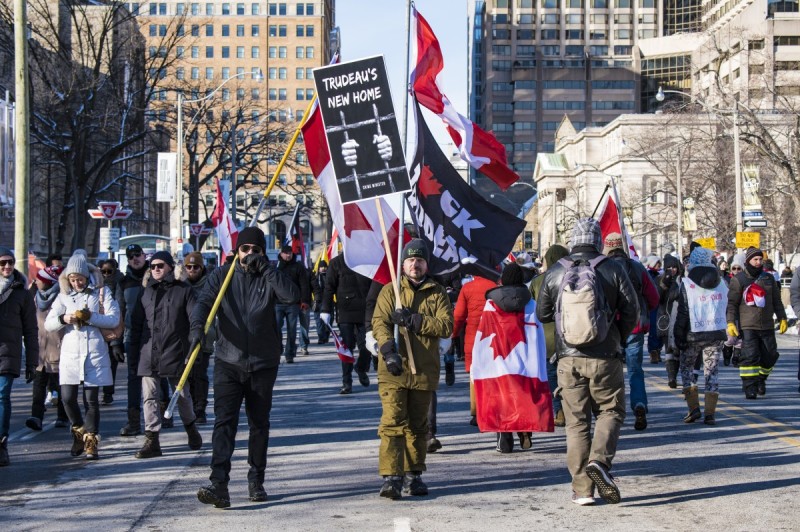
Supporters of the “Freedom Convoy” in Toronto, February 5, 2022. Photo by Michael Swan/Flickr
The following is an excerpt from Confronting the Resurgent Right, a new collection edited by Miriam Edelson with a foreword by Niigaanwewidam James Sinclair. It was published in May 2026 by the University of Manitoba Press. For more information, visit www.uofmpress.ca.
It is a time of great social, economic and political change. Democracy is at stake and Canada is not immune to its potential demise. From the impact of tariffs on workers and small businesses, to the backpedalling by successive governments on women’s and gender equality issues, to the more brazen appearance of neo-Nazi fight clubs and adoption of deleterious environmental policies, our country is facing difficult problems. The thought architecture of the far-right poses dangers to Canada’s economy and social fabric. Fascism is on the rise and Canadian civil society has enormous challenges with which to contend.
In addition, several significant events have emboldened the resurgence of the right in Canada. The re-election of US President Donald Trump in 2024 is perhaps most noteworthy—and dangerous. We are well into his second mandate and his readiness to circumvent Congress while attacking courts, universities, and DEI (diversity, equity and inclusion) programs, detaining citizens and deporting people without due process is evident. Extreme right ideology is upending democratic norms, laws and institutions very quickly and unsavoury practices impact Canadian politics and society. For example, Robert F. Kennedy Jr., secretary of the US Department of Health and Human Services and the Centre for Disease Control and Prevention, has embedded anti-vaccine disinformation in public health policy. That type of health policy is spilling over to Alberta, and it certainly fuelled the trope of individual freedom manifest in the 2022 “Freedom Convoy.”
In late January of that year, I was arriving in Ottawa to visit friends when we encountered traffic wrangles and were rerouted by the car’s GPS. We could hear the rumble of trucks rolling into town in the near distance. The noise turned out to be from the self-described “Freedom Convoy” as it entered the city. Later that day, when I saw on television the trucks draped with Confederate flags and Nazi symbols, I felt a deep stirring of emotion, as a Jew and a woman.
Like many Canadians, I was shocked, even horrified, to see swastikas and other symbols celebrating racial injustice displayed so brazenly. I was both fascinated and utterly repelled by what I saw. My response was visceral, a combination of fear and anger at seeing displays of hate strut so unashamedly. I knew instinctively that the roots of that hatred run deep.
I learned about fascism at my father’s knee. I was ten years old when he explained to me that he was not a pacifist because some forces in the world have to be fought. Fascism was one such force, and he had enlisted to fight in the Second World War because of it. My father was wounded on a beach in
France, earning a Purple Heart from the US Army. He was not a man who glorified his memories of the war, but he did teach us to deplore the swastika and “goose step” march of the Nazis, and what they stood for.
Back home in Toronto, I asked myself what I could do to combat the right-wing politics and conspiracy theories motivating that odd conglomeration of people converging in Ottawa. Wanting to understand more about the right, its history in Canada and elsewhere, and its deepening impact on our politics and society, I felt compelled to act and recognized it was not something I could do on my own. I decided to ask people who study the right and those who militate against it—from several different perspectives—what they thought.
Two related questions propelled this project: (a) how to understand the resurgence of the right in Canada, and (b) what paths of resistance can workers and communities adopt to counter the far-right? I believe some meaningful answers to these questions are offered in the various essays in the resulting book. The point is not to claim the “truth” but to spark conversations that challenge reckless conservatism. Going forward, we need to find a way to work together, to build coalitions in civil society, and to expose and counter the regressive forces that spew hate.
Confronting the Resurgent Right represents a unique approach in which intellectuals and organic intellectuals (activists) have come together to investigate a serious societal problem. It provides a combination of perspectives that shed light on the complexity of the subject in ways that give academic ground to activism and a militant voice to objective analysis.
It examines the impact of far-right movements primarily in English Canada, both in and outside of Parliament. It explores the right’s origins, strategies online and offline, and the consequences of its discourse. As the authors in the volume passionately identify, the rise in far-right activities, including hate crimes, violent attacks, and the proliferation of extremist ideologies online, have dangerous implications for Canadians. Most often, these groups target marginalized communities, and particularly Indigenous peoples, women, Black and Brown people, immigrants, Muslims, Jews, and 2SLGBTQIA+ people.

In addition to their extremist vitriol and worse, these groups seek to undermine our social cohesion, democratic institutions, and values of inclusivity and pluralism. The resulting destabilization to social, political, and economic systems creates fertile ground for extremist political movements to gain momentum, as Canadians’ confidence in our institutions is undermined. The extent to which some of these right-wing activities and narratives change the civil discourse, and, essentially, give permission for viewpoints and activities that were previously unthinkable, demonstrates the normalization and mainstreaming of the right-wing program.
The February 2022 self-described “Freedom Convoy” constituted a significant turning point in the trajectory of this country’s right-wing forces. Capturing national media for over three frigid winter weeks, it also captured the imagination of many Canadians. Not the majority but a substantial number of people, many of whom were previously disinterested in politics and feeling disenfranchised, gleaned a sense of empowerment from the proceedings in Ottawa. This feeling ought not to be ignored by those of us committed to building a society characterized by social justice rather than the pursuit of individual aims. That dynamic political moment is touched upon in several essays in this collection, analyzing its trajectory and legacy.
In Ottawa, Toronto, Winnipeg, and other locations, community solidarity movements have developed and are active. Involving labour councils and civil society organizations, as well as community residents, the movements are attempting to counter the right’s venom. Communities are organizing to ensure that residents’ voices are heard and anti-trans movements at schools are curtailed. Examples of successful organizing against the right are included in several chapters.
It is important that we understand concerns and fears voiced by the right and address their grievances with evidence-based argument and alternate perspectives. Moreover, we must not overlook root causes. Focusing solely on the symptoms of far-right extremism such as hate speech or violence, without addressing the underlying factors that contribute to its rise will not lead to long-term solutions. We need to understand and address the social, economic, and political grievances the far-right exploits, in order to understand and confront the cartography of their power.
In a time when the right is becoming mainstream, we must find a way to break down barriers between people and communities that compose the broad left and centre. With hopeful hearts we must reach out to others and provide a vision of the society we wish to live in. Often when the right comes to the fore, we allow them to define the agenda. Instead, together, we must offer an economic and social alternative that builds community and collective power. Unity empowers. We need to reclaim the agenda based on our own political programs. And, unlike past attempts to fight fascism, we must not fall prey to division. As Jia Tolentino reports from her interview with Naomi Klein in The New Yorker, “The history of the rise of fascism is not only a history of the power and organization of the fascist right; it’s also a story of fragmentation and refusal to make coalitions on the antifascist left.”
We have an opportunity today to organize differently, to welcome a broad range of movements to a united effort toward social justice. That is now certainly our most urgent collective task.
Miriam Edelson is a writer, settler and mother living in Toronto. Her literary non-fiction, personal essays and commentaries have appeared in the Globe and Mail, Toronto Star, various US, UK, and Canadian literary journals and on CBC Radio.